
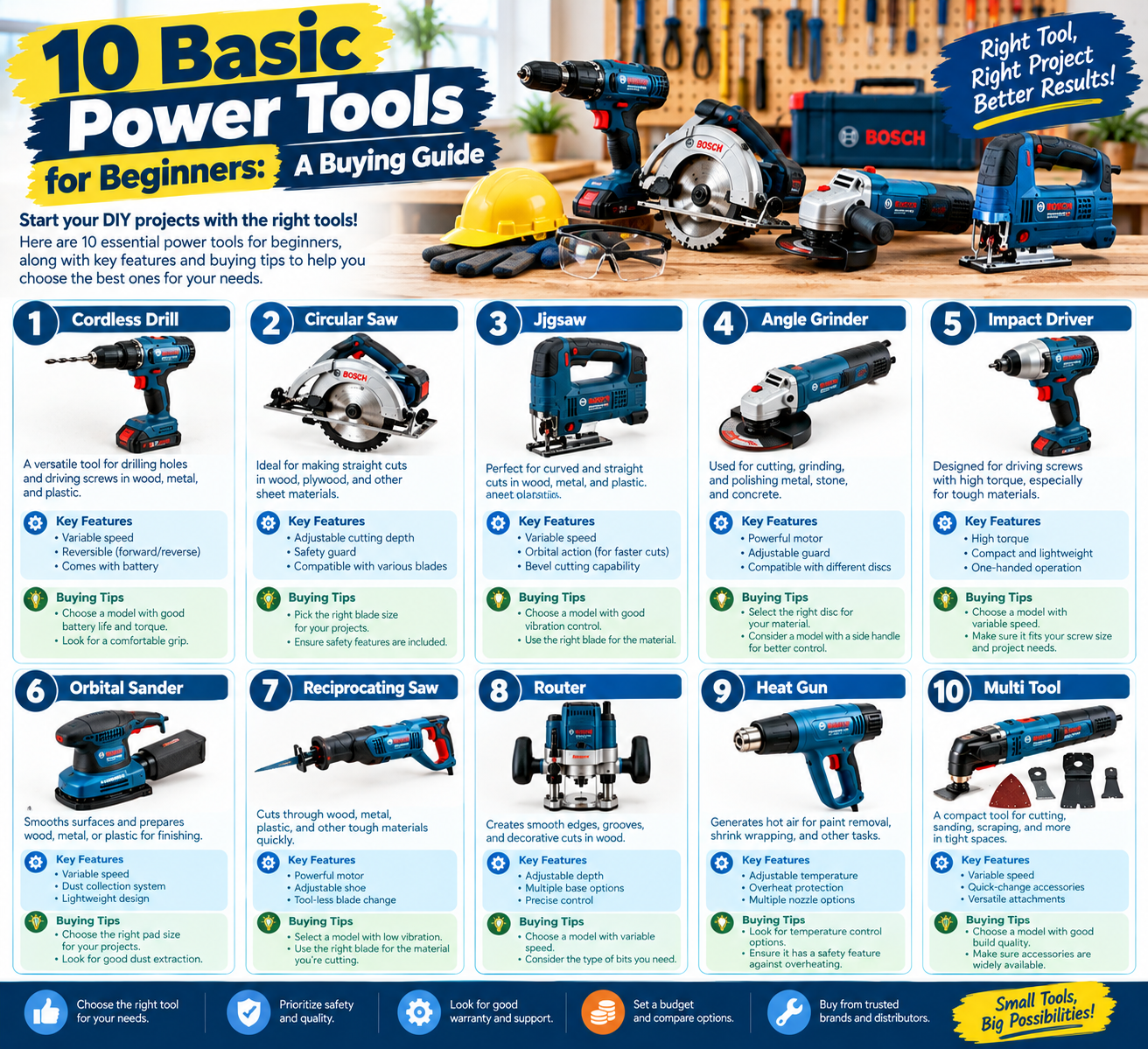
Walk into any hardware store and the wall of saws, drills and sanders can feel overwhelming. The good news is that you do not need everything at once. This guide covers the basic power tools for beginners: what each tool does, what to look for when buying, and which ones to get first for woodworking and DIY projects.
Which Power Tools Should a Beginner Buy First?
Match your tools to the projects you actually plan to build. As a rule of thumb:
- Start here: cordless drill, circular saw, random orbit sander.
- Add next: miter saw, table saw, router, nail gun.
- Add for a full shop: thickness planer, jointer, wood lathe.
Start Here: Everyday Power Tools
1. Cordless Drill
A cordless drill makes holes and drives screws, and it has largely replaced the manual screwdriver for most jobs. It is the single most useful tool a beginner can own.
- Voltage: 12V or less is fine for light, occasional work. 18V or 20V gives the power most serious DIYers want.
- Battery: starter batteries are often small (around 1.3–1.5 Ah). A 3 Ah or 4 Ah battery gives longer runtime.
- Chuck: a 1/2-inch keyless chuck holds more bit sizes and speeds up bit changes. 3/8-inch chucks are lighter but more limited.
- Speed and torque: choose variable speed with at least 10 clutch settings. Lower speeds give more torque for hard materials, while higher speeds drill faster.
2. Circular Saw
A handheld circular saw makes fast rip cuts and crosscuts in boards and sheet goods. With the right blade it can also cut materials such as cement board and plastic.
- Sidewinder: the motor sits beside the blade. These saws are compact, light and fast, and need no oil.
- Worm drive: the motor sits behind the blade for high torque, good for wet or hard wood. It needs regular oil maintenance.
- Hypoid: similar layout with sealed gears, so no oil is needed, and it runs quieter.
- Size and power: a 7-1/4-inch blade suits most jobs. For home projects, 4,000–5,500 rpm and a 15-amp motor are common.
- Corded or cordless: corded saws deliver steady power but are tied to an outlet. Cordless saws give freedom but depend on battery life.
3. Sander
Power sanding smooths, polishes and cleans surfaces on wood, plastic and metal far faster than hand sanding.
- Random orbit sander: the most popular choice for fine woodworking because it leaves a swirl-free finish.
- Palm sander: small and light, a good fit for beginners with simple projects.
- Belt and drum sanders: better for heavy material removal and larger jobs.
- Dust control: pick a model with good dust collection and always wear a dust mask.
Add Next: Precision Cutting and Shaping
4. Miter Saw
A miter saw uses a swing arm to make accurate angled cuts, ideal for crown molding, picture frames and framing work.
- Types: compound, sliding compound and dual sliding compound. Compound and sliding compound models suit DIY and home use, while dual sliding models are built for heavy-duty work.
- Blade size: common sizes are 7.25, 8.5, 10 and 12 inches. Bigger blades cut wider and thicker stock but need more motor power. A 15-amp motor is the most popular.
- Angles: a 45-degree bevel and miter range covers most work.
5. Table Saw
A table saw crosscuts and rips quickly and accurately, and its wide table handles most everyday board sizes.
- Portable saws (benchtop, compact and jobsite) usually use universal motors. They are lighter and cheaper, so beginners usually do better with these.
- Stationary saws (contractor, cabinet and hybrid) usually use induction motors, and they need a dedicated circuit and more floor space.
- Blade: check diameter, bore, thickness and tooth shape so the blade matches your material and the type of cut.
- Safety features: look for a blade guard, riving knife and, if possible, a braking system.
6. Router
A router cuts, trims and shapes wood, plastic and MDF using different router bits. It is the go-to tool for decorative edges on doors, cabinets and furniture, and you can use it handheld or mounted in a router table.
- Fixed-base router: simple and easy to control, good for edge work.
- Plunge router: best for cutting details in the middle of a board.
- Power: 1.25 to 1.75 horsepower is enough for most DIY work. Variable speed is strongly recommended.
- Cordless routers: pair best with a 3–5 Ah battery.
7. Nail Gun
A nail gun drives nails and brads fast and consistently. For beginners, three types cover most projects: brad nailers for trim and light work, framing nailers for structural work, and staplers for upholstery and thin panels.
- Weight: battery models weigh around 7 lb, while corded or pneumatic models often weigh 2–5 lb.
- Depth adjustment: makes sure each nail sits flush instead of sticking out or sinking too far.
- Safety: treat it like any firearm-style tool. Keep fingers off the trigger until the tool is on the work, and always wear eye protection.
Add for a Full Shop: Milling and Turning
8. Thickness Planer
A thickness planer shaves a board down to a consistent thickness and leaves a smooth, even surface. Benchtop planers suit home shops.
- Cutterhead: straight, spiral or helical. Helical heads are generally quieter and leave a smoother finish.
- What to check: motor power, board capacity, depth of cut and feed speed.
- Tip: a planer works best on a board that already has one flat face, which is where a jointer helps.
9. Jointer
A jointer creates a flat face and straight, square edges. It corrects cupping, bowing and warping, but it does not make the two faces parallel or reduce overall thickness. That is why jointers and planers are used together (or bought as a combination machine).
- Sizes: 6, 8, 12 and 16 inches are the most common widths. Benchtop models suit home shops, and stand-mounted ones suit workshops.
- Blades: high-speed steel (HSS) is common, but tungsten carbide lasts longer and resists wear better.
10. Wood Lathe
A wood lathe turns round parts such as bowls, plates, spindles and spoons, and it can also handle cutting, drilling and sanding.
- Size: mini, midi and full-size. Midi or full-size lathes suit most projects.
- Motor: 3/4 HP or higher is recommended.
- Swing and distance between centers: these set the maximum diameter and length you can turn.
- Speed control: variable speed is more practical than fixed speed.
Bonus: Hand Tools That Work With Your Power Tools
- Clamps: hold work steady for cutting, gluing and assembly. F-clamps, bar clamps, parallel clamps and spring clamps cover most needs.
- Wrenches: open-end, adjustable, socket and hex (Allen) wrenches handle bolts and fasteners during assembly and tool setup.
- Chisels: bevel-edged bench chisels trim joints and clean up corners. Paring and mortise chisels handle finer or specialized work.
Power Tool Safety Basics
- Wear safety glasses, hearing protection and a dust mask for every tool.
- Read the manual before the first use and learn every guard and switch.
- Clamp your workpiece instead of holding it by hand.
- Keep blades and bits sharp, because dull tools are more dangerous.
- Unplug the tool or remove the battery before changing blades and bits.
- Avoid loose clothing, jewelry and long hair near rotating parts.
How to Choose: Quick Buying Tips
- Buy for the project, not the brand. Tool type, motor power and speed range affect results more than the logo.
- Consider one battery platform. If you buy several cordless tools, staying with one battery system saves money.
- Check dust collection. Sanders, saws and routers all make fine dust, so a dust port is worth having.
- Compare corded and cordless. Corded tools give steady power for long jobs, while cordless tools are more convenient.
- Look at after-sales support. Replacement blades, brushes, batteries and warranty service keep a tool working for years.
- Consider used tools. A well-maintained used tool can save money, as long as you inspect it first.
Frequently Asked Questions
What is the first power tool I should buy?
A cordless drill is the best first purchase because it handles drilling and screwdriving for almost every project.
Do I need both a jointer and a thickness planer?
For milling rough lumber, yes. A jointer flattens one face and one edge, and the planer then makes the opposite face parallel at a consistent thickness. If you buy pre-surfaced lumber, you can skip both at first.
Is a table saw or a circular saw better for beginners?
A circular saw costs less, takes up no floor space and covers most basic cuts. A portable table saw is a good second step when you need repeatable, accurate rip cuts.
Are cordless power tools as good as corded ones?
Modern brushless cordless tools are powerful enough for most DIY work. Corded tools still win for long, heavy-duty jobs where steady power matters.
Conclusion
You do not need a full workshop on day one. Start with a cordless drill, a circular saw and a random orbit sander, then add specialized tools as your projects demand. Choose tools that match the work you actually do, put safety first, and build your collection gradually.


