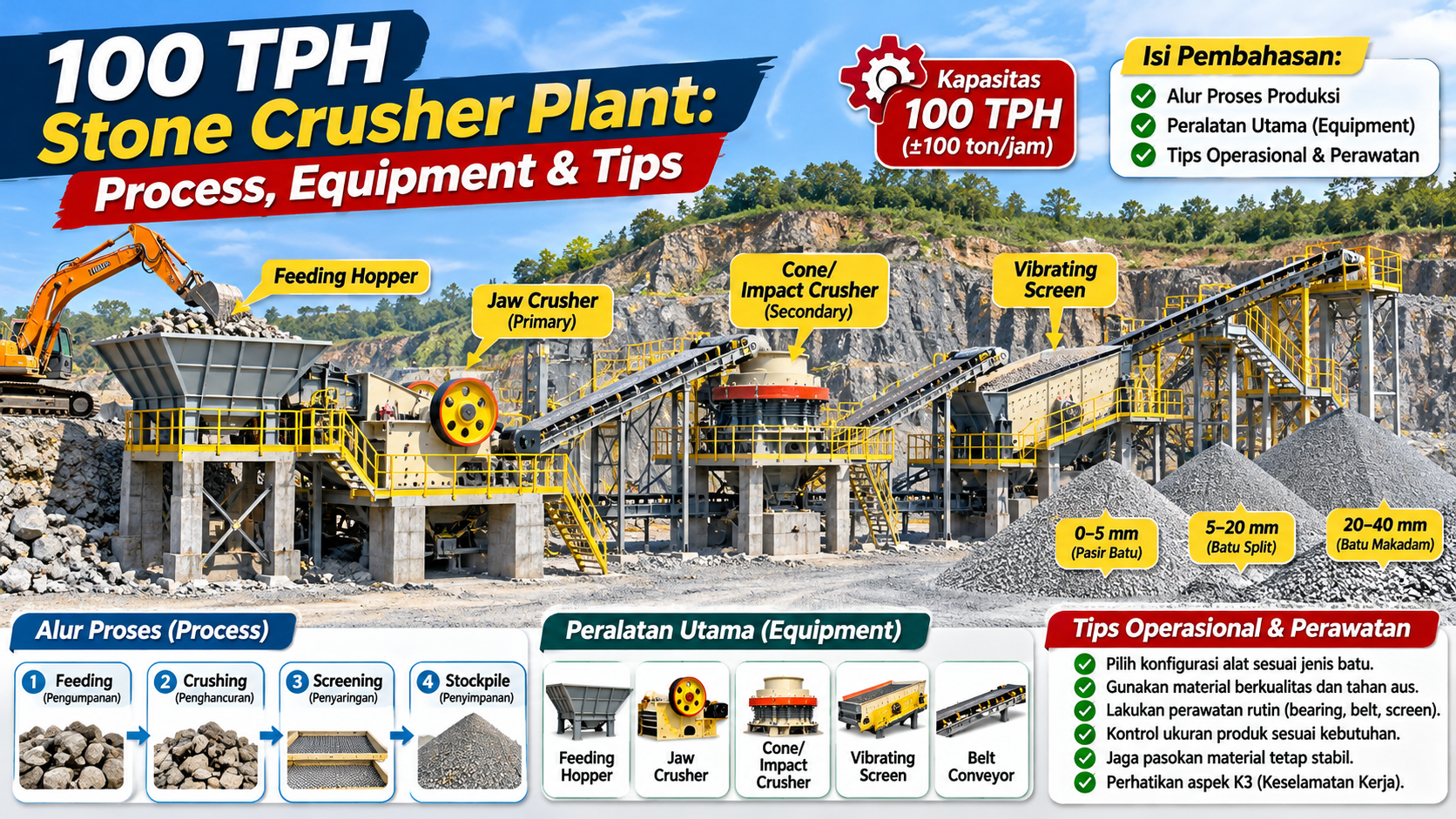
A 100 TPH stone crusher plant is one of the most popular setups for medium-scale quarries, road building and construction supply. It turns blasted or quarried rock into graded aggregates that can go straight into concrete, asphalt and road base. This guide explains how a 100 TPH plant works, what equipment it needs, and what to check before you buy.
What Does 100 TPH Mean?
TPH stands for tons per hour. A 100 TPH plant is designed to process about 100 tons of material every hour. Over an 8-hour shift that adds up to roughly 800 tons, and plants rated up to 150 TPH can reach around 1,200 tons per shift. Real output always depends on the rock type, feed size, moisture and how well the plant is maintained, so treat the rating as a design target, not a guarantee.
Materials a 100 TPH Plant Can Handle
- Limestone: soft to medium hardness, easy to crush and widely used for cement and construction aggregate.
- Granite and basalt: hard, abrasive rock that needs sturdier crushers and more frequent wear-part checks.
- River pebbles and gravel: rounded, hard stone that usually needs strong crushing force.
The Crushing Process, Step by Step
- Feeding: a vibrating feeder sends rock into the primary crusher at an even rate. It also removes fine soil and dust before crushing.
- Primary crushing: a jaw crusher breaks large rock down to a coarse intermediate size.
- Secondary crushing: an impact crusher or cone crusher reduces the material further and shapes the particles.
- Screening: a multi-deck vibrating screen sorts the crushed stone into size grades. Oversize pieces return to the secondary crusher for another pass. This is called a closed circuit.
- Conveying and stockpiling: belt conveyors carry each size to its own stockpile, ready for loading.
Key Equipment in a 100 TPH Plant
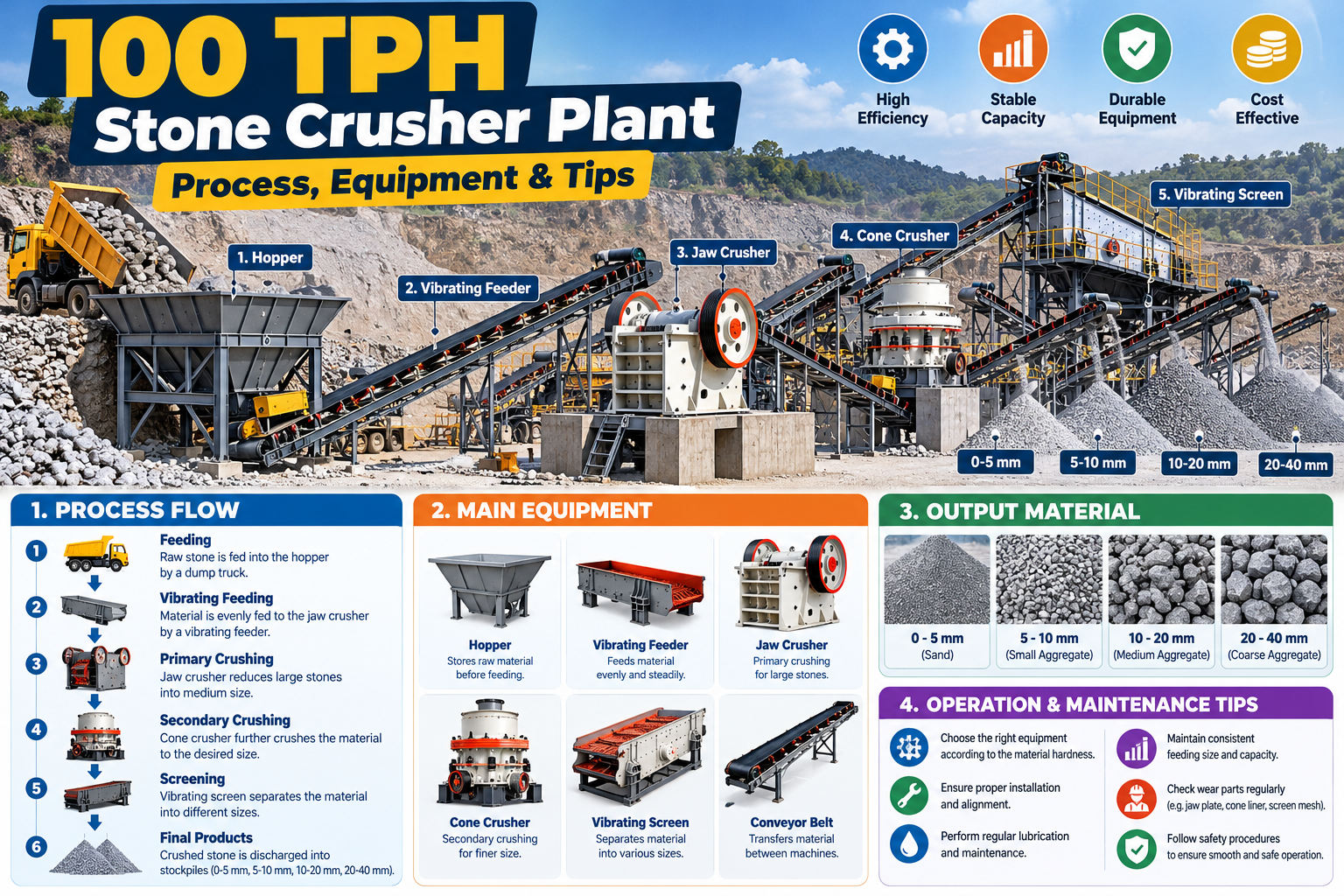
Exact models vary by supplier, but a typical 100–150 TPH configuration looks like this:
| Stage | Equipment | Typical example |
|---|---|---|
| Feeding | Vibrating feeder | ZSW1149, up to about 300 TPH |
| Primary crushing | Jaw crusher | PE600×900, feed size up to about 500 mm |
| Secondary crushing | Impact or cone crusher | PF1315 impact crusher or HP200 cone crusher |
| Screening | Circular vibrating screen | 3YK2160 three-deck screen |
| Transport | Belt conveyors | About 800 mm belt width |
| Dust control | Pulse-jet dust collector | Emissions target below 20 mg/m³ |
Common Output Sizes
Most plants of this size produce four standard aggregate grades:
- 0–5 mm (crusher dust or manufactured sand)
- 5–10 mm
- 10–20 mm
- 20–31.5 mm
Changing the screen mesh and crusher settings lets you adjust these sizes to match your project specification.
Jaw, Impact or Cone: Which Secondary Crusher?
- Impact crusher: good for softer, less abrasive stone such as limestone. It gives well-shaped, cubical product and a high reduction ratio.
- Cone crusher: better for hard and abrasive rock like granite and basalt. Wear costs per ton are usually lower on hard stone.
Stationary or Modular Plant?
A stationary plant suits a long-term quarry with fixed reserves. A modular or relocatable plant, with a skid or mobile frame, installs faster and can move between sites, which helps contractors working on several projects. Think about how long you will stay at one location before deciding.
How to Choose the Right 100 TPH Plant
- Know your rock. Hardness, abrasiveness, moisture and clay content decide which crushers and screens you need.
- Define your products. List the aggregate sizes and daily tonnage your customers actually buy.
- Check the feed size. Make sure the primary crusher opening matches your largest blasted rock.
- Plan for wear parts. Ask about the price and delivery time of jaw plates, blow bars, liners and screen mesh.
- Look at dust and noise control. Enclosed conveyors, spray systems and dust collectors help you meet environmental rules.
- Ask about service. Installation, commissioning, operator training, spare parts and warranty terms matter as much as the machine.
- Consider used equipment. A well-inspected used crusher can lower the starting cost, as long as you verify its condition and spare-part supply.
Tips to Keep Output Steady
- Feed the crusher evenly and avoid running it empty or overloaded.
- Keep the crushing chamber full enough for rock-on-rock crushing where the design allows.
- Lubricate bearings on schedule and check oil temperature.
- Inspect and rotate or replace wear parts before they fail.
- Clean screens regularly to prevent blinding, especially with damp material.
Frequently Asked Questions
How much stone can a 100 TPH crusher produce in a day?
At 100 TPH and 8 working hours, the theoretical output is about 800 tons per day. Actual output is usually lower once you account for stoppages, rock type and feed conditions.
What size of rock can go into the plant?
That depends on the primary crusher. A PE600×900 jaw crusher, for example, accepts feed up to about 500 mm.
Can the same plant make manufactured sand?
The 0–5 mm fraction is crusher dust and can be used as fine aggregate. For higher-quality sand, a dedicated sand-making machine and washing step are usually added.
Full categories of mining machinery and equipment
Conclusion
A 100 TPH stone crusher plant strikes a good balance between investment and output for quarries, road projects and aggregate suppliers. Match the equipment to your rock and your target products, plan for wear parts and dust control, and compare suppliers on service as well as price. With the right setup, you get steady, well-graded aggregate for years of production.